Beneath the Surface: How America's Farmers Are Turning Degraded Soil Into a Climate Asset—and a Financial One
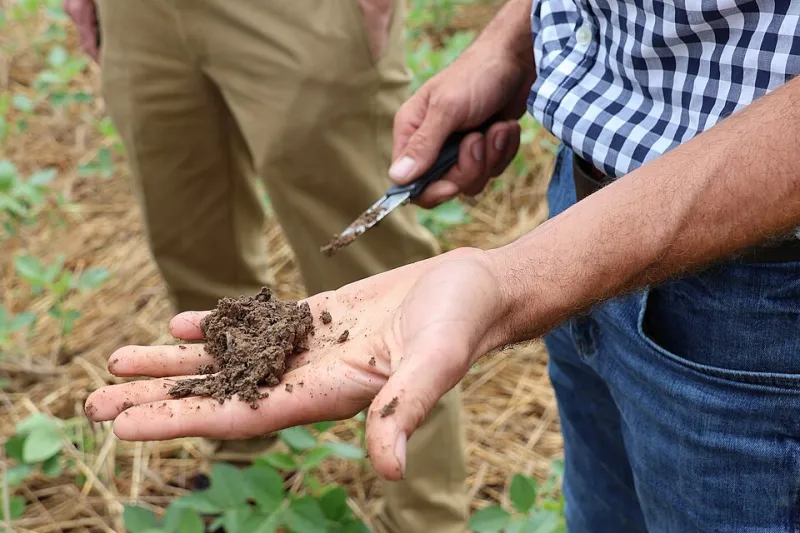
Photo: USDAgov, Public domain, via Wikimedia Commons
For most of the twentieth century, American agricultural policy treated soil as a substrate—an inert medium for delivering synthetic inputs to crop roots. The consequences of that philosophy are now visible in the numbers: the United States has lost roughly half of its original topsoil since the onset of industrial farming, and the carbon that once made those soils biologically rich has largely been oxidized into the atmosphere. The Great Plains, once among the most fertile and carbon-dense landscapes on Earth, now function in many regions as a net emitter of greenhouse gases rather than a sink.
Something significant is changing. Across the Corn Belt, the Mississippi Delta, and the rangelands of the Mountain West, a growing cohort of farmers is experimenting with practices that aim to reverse that carbon loss—rebuilding soil organic matter through cover cropping, reduced tillage, diverse crop rotations, and the strategic reintegration of livestock into cropland systems. They are doing so not only out of ecological conviction but because a nascent financial architecture is beginning to reward them for it.
What Regenerative Agriculture Actually Means
The term itself resists precise definition, which has become both its rhetorical strength and its scientific liability. At its core, regenerative agriculture refers to a suite of practices designed to restore the biological vitality and carbon content of agricultural soils, while improving water retention, reducing erosion, and decreasing dependence on synthetic fertilizers and pesticides. It draws on established disciplines including agroecology, holistic range management, and traditional indigenous land stewardship—synthesizing them into an approach that is, by design, adapted to local conditions rather than universally prescribed.
The carbon sequestration mechanism at the heart of regenerative agriculture is photosynthesis extended into the soil. Living plant roots feed carbon compounds to soil microorganisms, which incorporate that carbon into stable organic matter that can persist for decades or centuries. When tillage disrupts this microbial community, or when bare soil is left exposed between growing seasons, that sequestered carbon is released. The regenerative approach seeks to maximize the time that living roots occupy the soil, minimize physical disruption of the soil structure, and build the microbial communities that make long-term carbon storage possible.
Scientific estimates of the sequestration potential vary considerably. A widely cited 2017 paper in Scientific Reports suggested that optimized global regenerative practices could sequester more than three gigatons of carbon annually—a meaningful fraction of current global emissions. More conservative analyses from institutions including the Intergovernmental Panel on Climate Change suggest the realistic potential is lower, particularly when accounting for the permanence of stored carbon and the risk of re-emission during drought, fire, or management changes. The scientific community is actively refining these estimates, and the honest answer is that the full potential remains uncertain.
The Economics of Transition
For American farmers operating on thin margins in commodity markets, the financial case for regenerative transition has historically been difficult to make in the short term. Cover seed costs money. The yield dip that often accompanies the first several years of reduced-tillage farming can be financially punishing for operations carrying significant debt. Technical knowledge about managing complex rotations and integrating livestock is not uniformly distributed, and extension services have historically been oriented toward conventional production systems.
What is changing that calculus—sometimes dramatically—is the emergence of carbon credit markets and the entrance of institutional capital into agricultural carbon finance. Platforms including Indigo Ag, Ecosystem Services Market Consortium, and Nori have developed methodologies for measuring, verifying, and selling the carbon sequestered by participating farms. Farmers who adopt qualifying practices can generate carbon credits that are sold to corporate buyers seeking to offset their emissions, generating revenue that can meaningfully offset transition costs.
The economics are not uniformly compelling. Carbon credit prices on voluntary markets have ranged from roughly $15 to over $50 per metric ton of CO₂ equivalent, and the volume of credits an individual farm can generate depends heavily on its baseline soil carbon levels, the specific practices adopted, and the rigor of the verification methodology employed. For a Midwestern grain farm transitioning to no-till and cover crops, the additional revenue might represent a few dollars per acre annually—helpful, but not transformative on its own.
Where the financial picture becomes more interesting is in the convergence of carbon revenue with the agronomic benefits that accrue over time. Farms with higher soil organic matter require less synthetic nitrogen fertilizer, retain water more effectively during drought years, and in many cases demonstrate improved long-term yield stability. A 2022 analysis by the Rodale Institute found that after a multi-year transition period, regenerative systems could achieve economic parity with or superiority to conventional production in many cropping contexts, particularly as input costs rise.
Institutional Investment and the Scaling Question
Beyond individual farm economics, regenerative agriculture has attracted substantial attention from institutional investors seeking both financial returns and credible climate impact. General Mills, Cargill, and Walmart have made public commitments to transition millions of acres in their supply chains to regenerative practices by 2030. Private equity firms and impact investors have deployed capital into farmland acquisition and regenerative management, anticipating appreciation in both land value and carbon asset value as regulatory frameworks for agricultural carbon mature.
The scaling question is where optimism must be tempered by structural reality. The United States has approximately 900 million acres of agricultural land. Transitioning even a meaningful fraction of that acreage to genuinely regenerative management within a climate-relevant timeframe—the next decade or two—would require a transformation of agricultural extension services, financing mechanisms, supply chain incentives, and federal policy that has no precedent in modern American farming history.
The 2023 Farm Bill debate offered a window into the political complexity. Conservation programs including the Conservation Stewardship Program and the Environmental Quality Incentives Program, which can fund regenerative practice adoption, are chronically oversubscribed and underfunded relative to demand. Commodity support programs, by contrast, continue to incentivize the monoculture production systems that regenerative agriculture seeks to move beyond. Aligning federal agricultural policy with climate goals remains a profound political challenge.
The Integrity Problem in Carbon Markets
Perhaps the most consequential unresolved question in agricultural carbon finance is verification integrity. Carbon credits are only as valuable as the confidence buyers and regulators have that the sequestration they represent is real, additional, and permanent. Several high-profile controversies involving forest carbon credits have shaken confidence in voluntary carbon markets broadly, and agricultural carbon faces analogous challenges: soil carbon measurement is expensive, spatial variability within fields is substantial, and the risk of re-emission when farmers change practices or ownership transfers is difficult to manage contractually over the long time horizons that climate benefit requires.
The Science Based Targets initiative and other credibility frameworks are developing more rigorous standards for agricultural carbon claims, and the voluntary carbon market's leading registries are under pressure to tighten their methodologies. Federal engagement through the USDA's Regional Conservation Partnership Program and emerging regulatory frameworks in California and potentially at the federal level could provide the standardization and oversight that voluntary markets alone have struggled to achieve.
A Genuine Climate Opportunity—With Honest Caveats
Regenerative agriculture represents one of the more promising and underutilized tools in the American climate toolkit. Its potential to sequester carbon while improving farmer resilience, reducing agricultural chemical inputs, and rebuilding degraded ecosystems is substantiated by a growing body of field research. The financial ecosystem supporting its expansion is more developed than it was five years ago, and institutional interest continues to grow.
What it is not—and what responsible coverage must resist suggesting—is a silver bullet. Soil carbon sequestration is one component of a necessary climate response that also demands rapid decarbonization of energy systems, transportation, and industry. The carbon market mechanisms that currently drive much of the investment activity require significantly greater rigor and oversight to deliver on their promise. And the pace of voluntary adoption, however encouraging, is not yet commensurate with the scale of the agricultural transformation that climate science indicates is necessary.
The soil beneath American farmland holds genuine potential. Whether the financial, policy, and cultural conditions exist to unlock that potential at the speed the climate demands is the defining question of the regenerative agriculture moment—and the answer will be written not in boardroom pledges but in the accumulating organic matter of fields that are, acre by acre, beginning to heal.