Lines in the Land: How America's Fence Lines Fragment the Living World
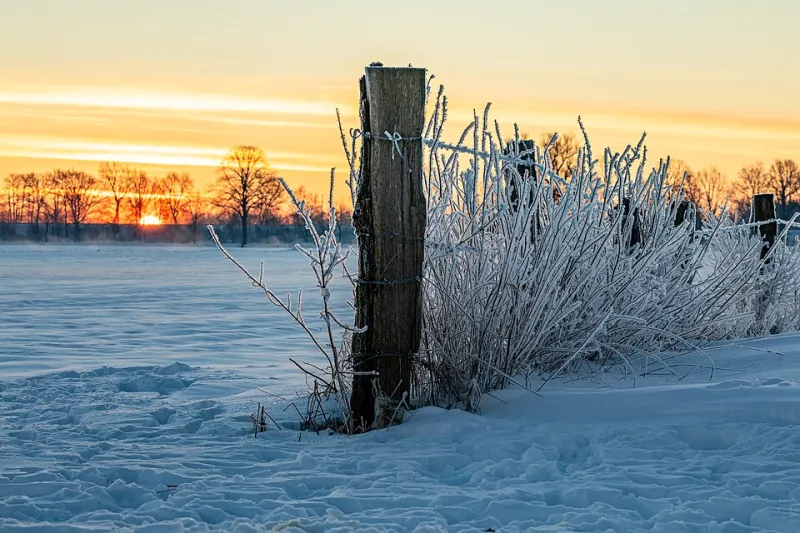
Photo: Dietmar Rabich, CC BY-SA 4.0, via Wikimedia Commons
The fence is one of the most ordinary objects in the American landscape. It runs along rural roads, subdivision boundaries, pasture edges, and backyards. It is so common that it becomes almost invisible, a piece of infrastructure as unremarkable as a mailbox. But a fence is not merely a line on a plat map. It is a legal instrument made physical, and it has ecological consequences that extend far beyond the property it encloses.
The Geometry of Ownership
The United States has a long and complicated relationship with fencing. In the nineteenth century, barbed wire helped transform the open range into enclosed pasture, reshaping the Great Plains and the cultures that depended on them. Later, suburban development translated the property line into picket, chain-link, and vinyl. The fence became a symbol of privacy, security, and clear boundaries. It also became a default response to liability, pets, children, livestock, and neighbors.
That default has a cost. From an ecological standpoint, a landscape is not a collection of parcels. It is a system of flows: water, seeds, insects, pollen, predators, prey, fire, and genes. Fences interrupt those flows. Some interruptions are obvious, as when a solid barrier blocks a deer or a pronghorn. Others are subtler, as when a mesh fence prevents amphibians from reaching breeding ponds or a chain-link barrier fragments pollinator habitat into isolated patches.
What a Fence Does to a Watershed
The ecological effects vary with design. A barbed-wire fence with a wide top wire may be passable for some species and lethal for others. A woven-wire fence can entangle wildlife. A solid privacy fence can block wind, alter snow accumulation, and change microclimates. In dry landscapes, fences can concentrate grazing pressure and alter vegetation along the line. In fire-prone landscapes, they can complicate emergency access and disrupt the movement of large herbivores that shape fuel loads.
The deeper problem is fragmentation. When habitat is divided into smaller pieces, species that need large territories or seasonal routes lose access to critical resources. Mule deer and elk may be cut off from winter range. Pronghorn may find migration routes blocked. Sage grouse may avoid areas near tall structures and fences. Smaller creatures face their own barriers: frogs, turtles, snakes, and small mammals can be injured or killed at fence lines, while insects and plants experience a different kind of fragmentation through altered shade, moisture, and disturbance.
Climate change raises the stakes. As temperatures shift and precipitation patterns become less predictable, many species will need to move to track suitable conditions. A landscape that is permeable today may be essential tomorrow. A landscape that is already diced by fences may have nowhere for species to go.
The Corridor Turn
In 2026, a growing number of land trusts, wildlife agencies, tribal nations, and private landowners are treating permeability as a conservation goal. The tools are not glamorous. They include wildlife-friendly fencing standards: smooth wire instead of barbed, wider spacing between wires, flagging to increase visibility, and gates or gaps at key crossing points. They include fence-removal programs on retired agricultural land and voluntary easements that keep corridors open. They include mapping efforts that identify where roads, fences, and development combine to pinch wildlife movement.
Some Western states and communities have moved more deliberately toward corridor policy, recognizing that migration routes cross multiple ownerships and cannot be protected one parcel at a time. The politics are delicate. Property rights are deeply held in the American West, and any conversation about removing or modifying fences can sound like an attack on ownership itself. The more productive framing is not abolition but adaptation: fences can be redesigned, relocated, or opened seasonally without erasing the boundaries that landowners rely on.
Permeability as a Public Good
This is where the fence question becomes larger than wildlife. American land-use patterns often treat ecological connection as an afterthought, something to be accommodated after parcels are platted and sold. But habitat connectivity is a public good. It supports biodiversity, resilience, water quality, and the ability of ecosystems to adapt under stress. It does not respect property lines, and it cannot be secured by a single landowner acting alone.
A more permeability-minded approach would treat movement as a legitimate land-use consideration. That could mean subdivision codes that require wildlife-friendly fencing in sensitive areas. It could mean conservation easements that explicitly protect corridors rather than only preserving isolated patches. It could mean local programs that help landowners replace dangerous fencing, share costs, and remove obsolete barriers. It could mean making fence removal part of restoration and wildfire planning rather than an unusual act of ecological goodwill.
The Unfenced Future
The American landscape will never be unfenced. Nor should it be. Fences do real work: they contain livestock, protect crops, keep pets safe, and mark boundaries that people depend on. But the current default is close to thoughtless. We build fences because property lines exist, because liability is feared, because privacy is valued, and because it is easier to enclose than to negotiate.
The alternative is not a borderless continent. It is a landscape where boundaries are drawn with more care. A fence can be a wall or a filter. It can divide habitat or simply define a pasture. It can block a migration route or leave room for one. In an era of climate disruption, the difference matters. The line in the land is not just a property line. It is an ecological decision, repeated millions of times, with consequences that run far beyond the yard.