Servers Never Sleep, and Neither Does Their Thirst: The Climate Price of America's Data Obsession
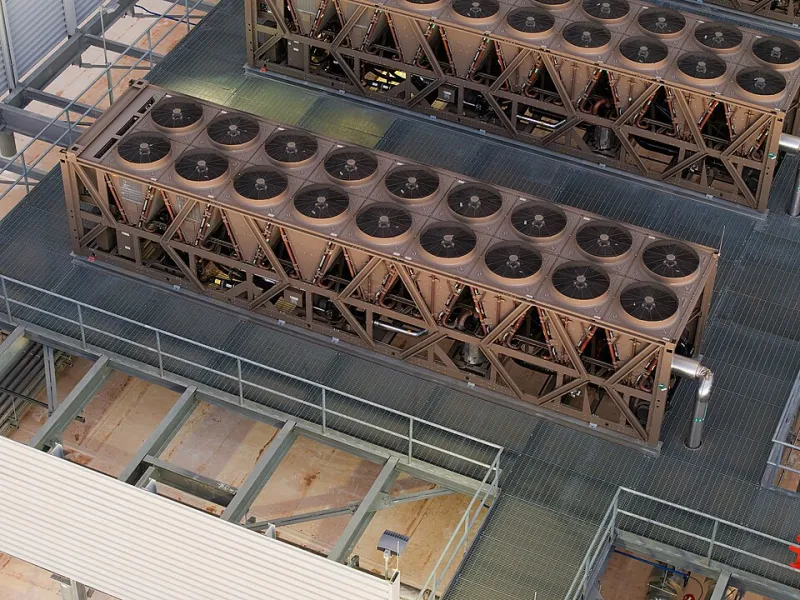
Photo: Rsparks3, CC0, via Wikimedia Commons
Somewhere outside Phoenix, in a stretch of desert that receives fewer than eight inches of rain per year, a data center the size of several city blocks is drawing millions of gallons of water from an already strained municipal supply. It is not making anything tangible. It is keeping computers cool. And it is doing so around the clock, every day of the year, regardless of drought conditions, water table levels, or the long-term hydrological consequences for the surrounding region.
This is not an anomaly. It is the operating reality of an industry that has positioned itself as the backbone of the modern economy while quietly accumulating one of the most consequential environmental footprints in the United States.
The Cooling Imperative Nobody Talks About
Data centers are, at their most fundamental level, machines that generate heat. Processors, memory units, networking equipment, and power supply systems all produce thermal energy as a byproduct of operation, and that heat must be continuously removed to prevent equipment failure. The infrastructure dedicated to this task — chillers, cooling towers, computer room air handlers, and evaporative systems — consumes energy and water at rates that dwarf most industrial comparisons of comparable economic output.
According to the Lawrence Berkeley National Laboratory, data centers in the United States consumed approximately 200 terawatt-hours of electricity in a recent measured year, representing roughly 4 percent of total national electricity consumption. That figure, already significant, is widely expected to climb sharply as artificial intelligence workloads — which require far denser computational power than conventional cloud services — become a larger share of total demand. Some industry analysts project that AI-related data center electricity consumption alone could double or triple within the next five years.
What those electricity figures do not fully capture is the water dimension. Evaporative cooling, the dominant thermal management strategy at large-scale facilities, works by allowing water to absorb heat and evaporate into the atmosphere. The process is energy-efficient relative to purely mechanical alternatives, but it is extraordinarily water-intensive. A single hyperscale data center can consume between one and five million gallons of water per day — volumes comparable to those required by mid-sized agricultural operations or small municipalities.
Geography of a Growing Problem
The location decisions of data center developers have created a troubling mismatch between water demand and water availability. Northern Virginia hosts the highest concentration of data center capacity in the world, and while its climate offers some natural cooling advantages, the region's aquifer systems and utility infrastructure are facing escalating pressure. Texas, Arizona, Nevada, and other water-scarce Sunbelt states have attracted enormous data center investment through favorable tax structures and land costs, even as they navigate some of the most severe long-term water stress in the nation.
This geographic irony is not lost on environmental advocates. Communities in the American Southwest are already managing the downstream effects of climate change on precipitation patterns and river flows. Introducing industrial-scale water consumers into those communities — facilities that operate under long-term contracts insulating them from the price signals that might otherwise incentivize conservation — compounds an already precarious situation.
The Colorado River compact negotiations that have consumed federal and state resources in recent years offer a cautionary frame. Agricultural users have faced curtailments, cities have paid premium prices for alternative supplies, and ecosystems dependent on consistent river flows have suffered measurably. Data centers, by contrast, have largely continued operating under arrangements that do not require them to internalize the full social cost of their consumption.
What the Sustainability Reports Leave Out
The major technology companies operating large data center portfolios — Google, Microsoft, Amazon, Meta, and others — have published sustainability commitments that, on their surface, appear serious and substantive. Carbon neutrality pledges, renewable energy procurement agreements, and water replenishment programs all feature prominently in their annual environmental reports.
Examining these commitments more carefully, however, reveals a pattern of selective accounting. Renewable energy certificates, for instance, allow a company to claim clean power consumption without necessarily ensuring that the electricity physically flowing to its facilities at any given moment comes from a zero-carbon source. Grid-level carbon intensity varies by hour and by region, and the mismatch between when renewable certificates are generated and when data centers actually draw power can be substantial.
On water, the gaps are arguably more significant. Replenishment programs — in which companies fund watershed restoration projects intended to return water to the hydrological system in volumes equal to what their facilities consume — are frequently cited as evidence of responsible stewardship. But the water replenished through such programs is rarely returned to the same basin from which it was drawn, and the fungibility of water across geographically distinct watersheds is a concept that hydrology does not support. Replenishing a wetland in the Pacific Northwest does not meaningfully offset consumption stress on an Arizona aquifer.
Technological Alternatives and Their Limits
The engineering community has not been idle. Several alternative cooling approaches have moved from research stages into commercial deployment, and their potential merits genuine attention.
Liquid cooling — in which coolant is circulated directly through server chassis or even individual processor components — dramatically reduces the need for air-side cooling infrastructure and can achieve significant reductions in both energy and water consumption. Microsoft's experimental underwater data center project demonstrated that ambient seawater could serve as a cooling medium with compelling efficiency outcomes. Immersion cooling, which submerges computing hardware in thermally conductive but electrically inert fluids, has attracted investment from several major operators and is beginning to appear in production environments.
Free cooling, which exploits cold outdoor air during winter months in northern climates, offers another partial solution. Data centers in Minnesota, Oregon, and Scandinavia have leveraged this approach to reduce mechanical cooling loads substantially. The tradeoff, of course, is that free cooling is climatically constrained — it provides limited relief in warm regions and becomes less effective as average temperatures rise.
The honest assessment of these technologies is that none of them, individually or in combination, eliminates the cooling challenge at the scale that AI-driven demand growth implies. They reduce the intensity of the problem; they do not resolve it.
Toward Accountability That Matches the Scale
Regulatory frameworks governing data center environmental performance in the United States remain fragmented and largely inadequate. A handful of states have begun exploring disclosure requirements for water consumption, and the Securities and Exchange Commission's climate disclosure rules — currently subject to ongoing legal challenge — would introduce some degree of standardized carbon reporting. But there is no federal standard specifically addressing data center resource efficiency, no mandatory water accounting framework, and no mechanism for ensuring that the environmental costs borne by local communities are reflected in the economics of facility operation.
The technology industry has benefited enormously from public trust in its capacity for self-governance. That trust has not been entirely misplaced — genuine engineering progress has occurred, and some sustainability commitments reflect authentic organizational commitment rather than mere public relations. But the structural incentives facing data center operators still reward throughput over efficiency, and the communities hosting these facilities still lack meaningful recourse when their water and energy resources are drawn down in service of global computing demand.
America's data infrastructure will continue to grow. The question is whether that growth will be governed by accountability commensurate with its ecological footprint, or whether the cooling towers will keep running and the water tables will keep dropping while the quarterly earnings reports celebrate another record quarter of cloud revenue. The servers never sleep. The climate cannot afford for the regulators to, either.