Plugged In, Tuned Out: The Staggering Environmental Cost of America's Smartphone Charging Ecosystem
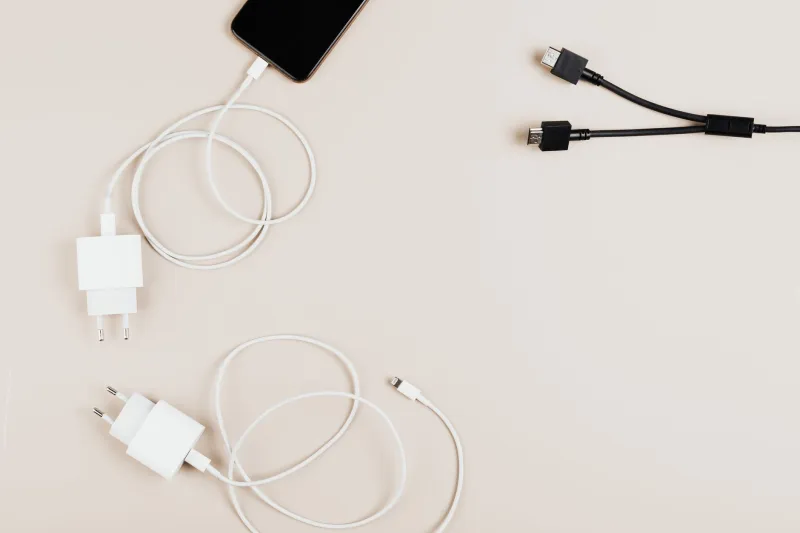
The smartphone has become the defining artifact of contemporary American life. It wakes us in the morning, navigates our commutes, mediates our relationships, and follows us to bed. What receives far less attention is the quiet infrastructure that keeps it alive—the tangle of cables, charging bricks, wireless pads, and power banks that accumulate in our drawers, our cars, and eventually our landfills. Collectively, that infrastructure represents an environmental liability that the technology industry has been slow to acknowledge and even slower to address.
The numbers are striking. The United States alone is home to roughly 270 million smartphone users. Most of those users own more than one charger. Many own several. When a phone is replaced—typically every two to three years—the charger rarely follows it to the recycling bin. Instead, it migrates to a kitchen drawer, a junk box in the garage, or the trash. The Environmental Protection Agency estimates that Americans discard approximately 151 million mobile phones annually, and the chargers associated with those devices represent a significant fraction of the nation's growing e-waste burden. Unlike the phones themselves, chargers contain a concentrated mixture of plastics, copper, and low-grade electronic components that are rarely economically viable to recycle at scale.
The Proliferation Problem Nobody Is Talking About
For much of the past two decades, American consumers have been subjected to a revolving door of incompatible charging standards. Apple's proprietary Lightning connector, introduced in 2012, rendered millions of existing accessories obsolete overnight. Micro-USB, once the near-universal standard for Android devices, gave way to USB-C at different rates across different manufacturers, leaving consumers navigating a confusing landscape of partially compatible cables and adapters. The result is a nation awash in functional-but-orphaned charging equipment with no clear path to reuse or responsible disposal.
Europe moved to address this problem legislatively. The European Union mandated USB-C as a universal standard for portable electronics, with full enforcement taking effect in late 2024. Apple, responding to regulatory pressure rather than market forces, adopted USB-C on its iPhone 15 lineup—a change that was widely celebrated but arrived roughly a decade after the technology industry could have implemented it voluntarily. In the United States, no comparable federal mandate exists. Standardization has proceeded incrementally and unevenly, driven primarily by competitive dynamics rather than any coherent policy framework aimed at reducing waste.
The consequences of that policy vacuum are tangible. Consumer electronics researcher Gartner has estimated that over a billion chargers are shipped globally each year—many of them redundant, many of them destined for landfills within a few years of manufacture. Each charger requires raw materials, energy-intensive manufacturing, and transcontinental shipping. The carbon embedded in a single charger is modest in isolation. Multiplied across a population of hundreds of millions of devices, it becomes a meaningful and largely unnecessary contribution to the nation's emissions profile.
The Energy Drain That Never Stops
Beyond the physical waste of discarded hardware lies a subtler problem: the energy inefficiency of the charging ecosystem itself. Every charger plugged into a wall outlet draws power, even when no device is connected. This phenomenon—commonly called a phantom load or standby power—is a well-documented characteristic of transformer-based electronics. The individual wattage is small, often less than half a watt per device. But when aggregated across tens of millions of households, each with multiple charging devices in a perpetual state of idle readiness, the cumulative drain on the national grid is substantial.
The Lawrence Berkeley National Laboratory has studied standby power consumption extensively and found that it accounts for approximately five to ten percent of residential electricity use in American homes. Charging infrastructure represents only a fraction of that total, but it is among the most pervasive and least scrutinized contributors. Unlike a television or a gaming console, a charger plugged into a baseboard outlet rarely registers as a device consuming energy at all. It is, for most Americans, simply part of the background—invisible, unmetered, and unquestioned.
Wireless charging compounds the problem in ways that are underappreciated even among technologically literate consumers. Inductive charging, the technology underlying Qi-standard wireless pads and MagSafe accessories, is inherently less efficient than wired charging. Depending on the specific implementation and alignment between the device and the pad, wireless charging can waste between 25 and 47 percent more energy than a direct cable connection to accomplish the same task. As wireless charging pads proliferate across American homes, offices, hotel rooms, and airports, that inefficiency multiplies quietly and continuously.
Synchronized Demand and Grid Stress
There is also a temporal dimension to the smartphone charging problem that grid planners are beginning to take seriously. American charging behavior is remarkably synchronized. A significant proportion of the country's smartphone users plug in their devices at roughly the same time each evening—between 9 p.m. and midnight—creating a predictable surge in residential electricity demand that coincides with the period when renewable energy generation, particularly solar, is at its lowest. This synchronized demand pattern is not a trivial inconvenience. It is a structural challenge for grid operators attempting to balance supply and demand in real time.
So-called smart charging technologies, which theoretically allow devices to draw power during off-peak hours when grid stress is lower and renewable generation is higher, have been promoted as a partial solution. In practice, however, the adoption of these features has been limited. Many consumers are unaware that the option exists. Many others override it instinctively, prioritizing a full battery in the morning over any abstract benefit to grid stability. The smart charging features embedded in iOS and Android operating systems are useful tools, but they are opt-in, poorly marketed, and easily defeated by the simple human desire for reassurance that one's phone will not die before noon.
What Genuine Solutions Require
Addressing the environmental footprint of America's smartphone charging ecosystem will require action at multiple levels simultaneously. Federal standardization policy, modeled on the European Union's approach, represents the most straightforward and highest-impact intervention available. A mandatory USB-C standard for all consumer electronics sold in the United States would not eliminate charger waste overnight, but it would dramatically slow the pace of obsolescence and create genuine opportunities for charger reuse across device generations.
Manufacturers bear responsibility as well. The practice of bundling chargers with new devices—already abandoned by Apple and Samsung for flagship models—should become the industry norm rather than the exception. Selling phones without chargers is only environmentally meaningful, however, if it is accompanied by robust take-back and recycling programs for the chargers consumers already own. Without those programs, unbundling merely shifts the waste rather than reducing it.
At the infrastructure level, investment in time-of-use electricity pricing—which incentivizes consumers to shift discretionary energy consumption, including device charging, away from peak demand periods—could meaningfully reduce the grid impact of synchronized charging behavior. Several states, including California and Illinois, have begun implementing such pricing structures, but national adoption remains limited.
The smartphone is not going away. Neither is the need to charge it. But the assumption that the current charging ecosystem—wasteful, inefficient, and largely unregulated—represents an acceptable baseline deserves serious challenge. The energy and materials embedded in America's charging infrastructure are not a rounding error. They are a policy choice, and like most policy choices, they can be made differently.