Brined Rivers: The Hidden Climate and Water Cost of America's Winter Salt Habit
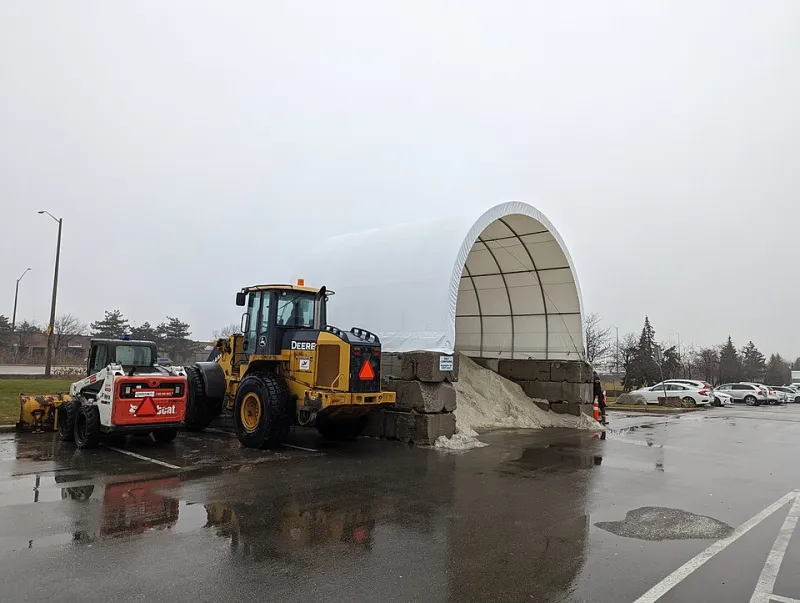
Photo: Sikander Iqbal, CC BY-SA 4.0, via Wikimedia Commons
Every winter, the American road network undergoes a chemical transformation. Trucks scatter rock salt across interstate lanes, subdivision streets, grocery-store parking lots, and apartment walkways. The immediate result is safer passage. The delayed result is a slow, cumulative salinization of the freshwater systems that receive the runoff.
The Road Becomes a Watershed
Sodium chloride does not disappear when the ice melts. It dissociates into sodium and chloride ions, and chloride is notably conservative in the environment: it does not degrade, volatilize, or readily bind to soil. Instead, it moves with water. Some of it reaches streams and lakes through storm drains and ditches. Some infiltrates shallow groundwater. Some lingers in soils and sediments, re-entering waterways during later storms. Over years and decades, the cumulative effect is a rising baseline of chloride in places that were once reliably fresh.
This is not merely an aesthetic problem. Freshwater salinization alters the chemistry of streams and can mobilize metals from sediments and plumbing. It stresses aquatic macroinvertebrates, amphibians, and fish, particularly during winter and early spring when chloride pulses coincide with sensitive life stages. It can also reach private wells and municipal intakes, forcing utilities to blend, treat, or find new sources. The costs do not stop at the water's edge. Chloride accelerates corrosion in bridges, rebar, vehicles, and water infrastructure, turning a winter maintenance expense into a long-term repair liability.
A Measure of Chloride
The scale of the practice is part of the challenge. The United States applies tens of millions of tons of road salt each winter, according to federal and industry estimates, though the exact figure varies with weather. Most of that tonnage is concentrated in the Northeast, Midwest, and mountain West, where freeze-thaw cycles are frequent and winter storms are routine. But the ecological footprint is not confined to snowy states. Parking lots, sidewalks, and private contractors add substantial loads in suburban and urban areas, often with less oversight than state highway departments receive.
Scientists have increasingly described this pattern as freshwater salinization syndrome: a combined problem of rising chloride, altered pH, increased alkalinity, and mobilized contaminants. The phrase matters because it moves the issue beyond the familiar image of a single salty stream. What is emerging is a regional-scale chemical shift, one driven by a practice that is decentralized, seasonal, and deeply embedded in American mobility and liability norms.
The Infrastructure Bill Comes Due
For decades, salt was treated as a cheap and reliable tool. It is cheap per ton, but not cheap per outcome. When corrosion, drinking-water treatment, road repair, and ecological damage are included, the true cost rises sharply. Municipalities increasingly face chloride limits in discharge permits and total maximum daily loads for impaired waters. Some utilities have had to shut down wells or dilute source water. Transportation agencies, meanwhile, are caught between public expectations of clear roads and growing evidence that the current volume of salt is unsustainable.
The 2026 Salt Playbook
In 2026, the most promising response is not a single substitute for rock salt. It is a more disciplined system for using less of it. Precision application is central: calibrated spreaders, pavement temperature sensors, weather forecasting tied to route-level decisions, and pre-treating roads with brine before storms arrive. Brine can use less salt overall because it adheres to pavement rather than bouncing off. Beet juice, cheese brine, and other organic additives can improve performance at lower chloride concentrations, though they are not universal solutions and must be evaluated for local water-quality effects.
Equipment matters, but so does governance. Some states and municipalities are revising procurement contracts to reward salt reduction rather than raw tonnage delivered. Others are requiring winter maintenance contractors to complete training and report application rates. A few are experimenting with chloride budgets for sensitive watersheds, an approach that treats salt like a pollutant with a cap rather than a commodity with an open-ended demand.
What a Smarter Winter Requires
The harder change is cultural. American drivers expect bare pavement, and liability concerns push public agencies and private property owners toward liberal application. But a safer winter does not have to mean a saltier one. It can mean better forecasting, smarter equipment, realistic service standards, and a public conversation about what level of winter mobility is worth what level of ecological cost.
Green technology alone will not resolve that tension. But it can make the trade-off visible. When a snowplow's spreader is calibrated, when a parking lot uses less salt because the pavement temperature is known, when a watershed has a chloride budget, the winter maintenance system begins to behave less like a blunt force and more like a managed input. That is the essential shift. The salt line is not only on the road. It is in the water, and it is moving.