The Debt Beneath the Dirt: How Industrial Farming's Ecological Borrowing Is Coming Due
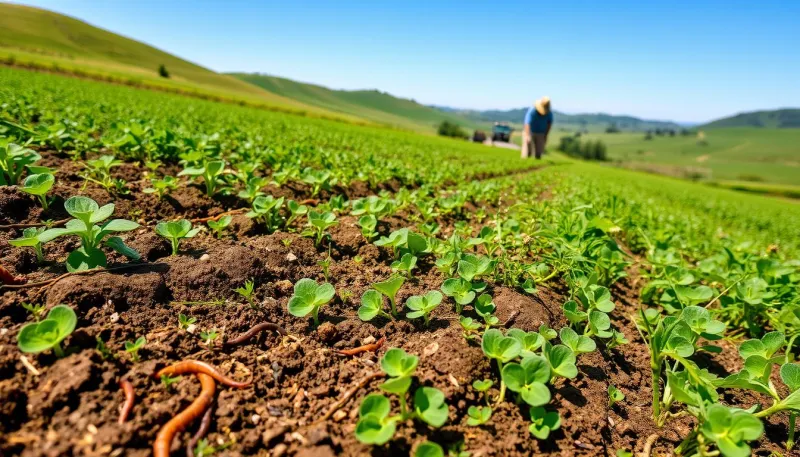
Photo: regenerative agriculture healthy soil cover crops American farm, via storage.googleapis.com
In the southern reaches of Kansas, a farmer named Dale Whitmore recently drilled a new irrigation well on land his family has worked for three generations. The well had to go 40 feet deeper than the one it replaced, sunk just 22 years ago. The Ogallala Aquifer—the vast underground reservoir that irrigates roughly 30 percent of all groundwater-fed cropland in the United States—has been declining for decades. In parts of Kansas, Texas, and Oklahoma, water tables have dropped more than 150 feet since large-scale irrigation began in earnest after World War II.
Whitmore's deeper well is a physical ledger entry for a debt that conventional agriculture has been accumulating for generations. The water was never priced. The soil carbon was never valued. The bees were never counted. And yet all of these things—aquifer recharge rates, microbial soil health, pollinator populations—are productive assets that generate economic value every single season. When they degrade, so does the farm's capacity to produce. The balance sheet just doesn't say so. Not yet.
Naming What Was Never Named
Ecologists have long used the term "natural capital" to describe the stocks of environmental resources—clean water, fertile soil, stable climate, biodiversity—that underpin economic activity. For most of American agricultural history, natural capital was treated as essentially infinite: a free input that could be drawn upon without consequence.
That assumption is now cracking under the weight of empirical evidence. A 2023 study published in Nature Sustainability estimated that the hidden environmental costs of US food production—including greenhouse gas emissions, water depletion, soil erosion, and biodiversity loss—amount to more than $1.1 trillion annually when externalized damages are fully accounted for. That figure exceeds the entire market value of US agricultural output in a typical year.
Put differently: if American farming had to pay for what it takes, it would not be profitable by conventional measures. The profit that does exist is, in substantial part, borrowed from the future.
"We've been running a business model that depends on liquidating assets and calling it income," says Dr. Miriam Salcedo, an agricultural economist at the University of Nebraska-Lincoln who studies the intersection of natural capital accounting and farm finance. "At some point, the assets run out. We're starting to see that in real time."
The Pollinator Ledger
Consider the honeybee. US Department of Agriculture data shows that managed honeybee colonies declined from roughly 6 million in the 1940s to fewer than 2.7 million today. Wild bee populations have fared even worse, with more than a quarter of North American native bee species facing some degree of extinction risk, according to the Xerces Society.
Pollinators contribute an estimated $15 to $34 billion annually to US crop production by enabling the reproduction of fruits, vegetables, nuts, and oilseeds. Almonds alone—a $5 billion California industry—are almost entirely dependent on commercial honeybee pollination. As colony collapse disorder and habitat destruction continue to erode pollinator populations, the farms that have historically received this service for free are beginning to pay for it directly, through increasingly expensive hive rentals and, in some cases, through yield declines that no amount of synthetic input can reverse.
The almond industry's pollination crisis is, in miniature, a preview of what broader pollinator collapse could mean for American food security. It is also a case study in how an ecosystem service, once destroyed, becomes a line item on the income statement.
Carbon as Currency
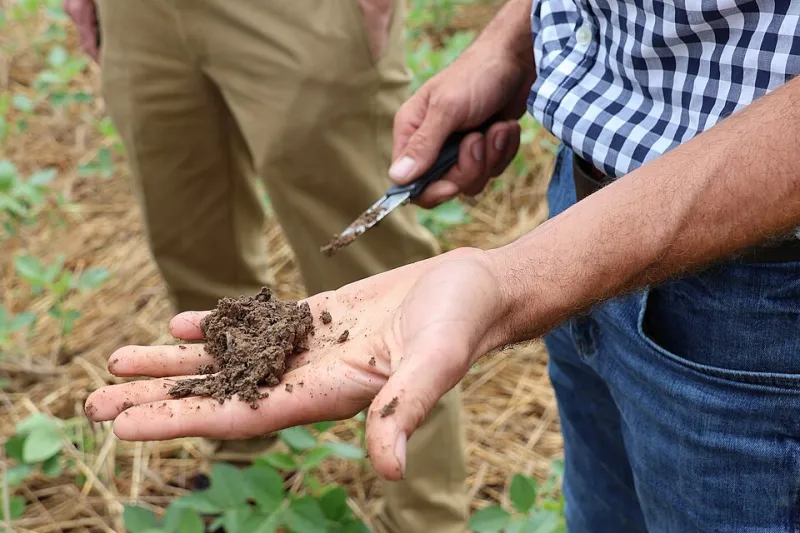
Soil carbon occupies a similarly ambiguous position in farm economics. Healthy agricultural soils contain vast reserves of organic carbon, accumulated over millennia through the decomposition of plant matter and the metabolic activity of billions of microorganisms. This carbon is not merely a climate variable—it is the physical substrate of soil fertility. Soils rich in organic matter retain more water, resist compaction, support more robust root systems, and require fewer synthetic fertilizer inputs to achieve comparable yields.
Conventional tillage practices—particularly the deep, frequent plowing that became standard after the mechanization of American farming—release this stored carbon into the atmosphere as carbon dioxide. The USDA estimates that cultivated soils in the US have lost between 50 and 70 percent of their original carbon stocks since European settlement. Every ton of carbon lost is, simultaneously, a unit of atmospheric warming and a unit of degraded agricultural productivity.
This double loss has begun attracting serious financial attention. Voluntary carbon markets, though still maturing and subject to legitimate criticism over verification standards, have opened a pathway for farmers who adopt carbon-sequestering practices—cover cropping, reduced tillage, rotational grazing—to monetize soil health improvements. Companies like Indigo Ag and Soil and More Impacts have built platforms that connect farmers with corporate buyers seeking to offset emissions, creating a revenue stream that did not exist a decade ago.
Regenerative Finance Takes Root
Beyond carbon markets, a broader architecture of regenerative finance is beginning to emerge. Impact investors and agricultural lenders are developing loan products that reward farmers for measurable improvements in soil health, water retention, and biodiversity. The idea is to align the incentive structure of farm finance with the long-term productivity of the land itself—rather than with commodity yields in any single season.
Rabo AgriFinance, one of the largest agricultural lenders in the United States, has piloted sustainability-linked loan programs that offer interest rate reductions to farmers who hit benchmarks for soil organic matter, cover crop adoption, or reduced synthetic nitrogen use. The logic is straightforward: a farm with healthier soil is a more creditworthy borrower over a 20-year horizon than one that is quietly liquidating its productive base.
In Iowa, a coalition of farmers working with the Practical Farmers of Iowa organization has documented that fields managed with diverse cover crop mixes and reduced tillage consistently outperform conventional fields during drought years—precisely the conditions that climate projections suggest will become more frequent across the Corn Belt. "The regenerative practices are essentially climate insurance," says coalition member and third-generation farmer Terri Halverson. "They cost more upfront, but they're the reason we still had a crop in 2022 when our neighbors didn't."
The Accounting Revolution
Perhaps the most consequential development is the slow but accelerating movement toward natural capital accounting in corporate agriculture. Major food companies—including General Mills, Unilever, and Cargill—have made public commitments to measure and reduce the environmental footprint of their supply chains, driven partly by investor pressure and partly by the recognition that supply chain resilience depends on the ecological health of the farms that feed them.
The Securities and Exchange Commission's climate disclosure rules, finalized in 2024, will require publicly traded companies to report on climate-related risks in their operations and supply chains. For food and agriculture companies, this creates a regulatory imperative to understand—and eventually account for—the natural capital risks embedded in their sourcing practices.
This is not charity. It is the belated recognition that what conventional agriculture has externalized for generations represents real financial risk: stranded assets in the form of depleted aquifers, supply chain disruptions from pollinator loss, and yield volatility driven by degraded soil biology. The ghost acres of industrial farming—land that appears productive on paper but is quietly losing its capacity to produce—are beginning to show up in the numbers.
For farmers willing to look honestly at their balance sheets, the picture is sobering. But it is also clarifying. The path toward ecological and economic resilience runs through the same practices: returning organic matter to depleted soils, restoring habitat for the insects that crops depend on, and treating water not as an infinite resource but as a finite inheritance. The debt beneath the dirt is real. So, increasingly, is the willingness to repay it.