Threads of Harm: The Toxic Chemistry Behind Your Wardrobe and the Brands Actually Doing Better
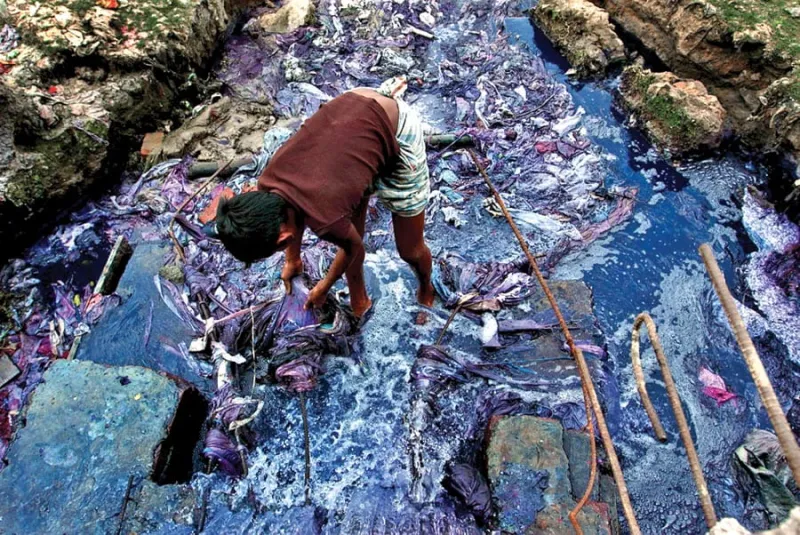
Photo: textile dye pollution river factory workers sustainable fabric, via blog.nus.edu.sg
The average American purchases roughly 68 garments per year. Most of those items will be worn fewer than ten times before being discarded. What rarely enters that consumer calculus is what happened long before the shirt arrived on a store rack—the chemical baths, the synthetic dyes, the finishing agents that make fabrics wrinkle-resistant, stain-proof, and flame-retardant. Behind those conveniences lies a contamination story that stretches from textile mills in South and Southeast Asia to rivers running visibly discolored through rural communities in Bangladesh, Indonesia, and India.
But this is not only a story about distant harms. The chemicals embedded in fast fashion have a way of traveling.
What's Actually in Your Clothes
Textile dyeing is the second-largest polluter of clean water globally, according to the United Nations Environment Programme. The process relies on a suite of synthetic compounds—azo dyes, formaldehyde-based resins, perfluorinated chemicals (PFAS), phthalates, and heavy metals including lead, cadmium, and chromium—many of which are classified as carcinogenic or endocrine-disrupting.
Azo dyes, which account for roughly 70 percent of all textile colorants, can break down under certain conditions into aromatic amines, a family of compounds linked to bladder cancer and other malignancies. PFAS, the so-called "forever chemicals" used to create water-repellent finishes on outerwear and activewear, have been detected in the bloodstreams of textile workers, in the breast milk of women living near manufacturing facilities, and increasingly in American drinking water supplies downstream from import processing and retail distribution centers.
Formaldehyde resins—applied to prevent wrinkling in dress shirts and khakis—off-gas into the air during production and remain detectable in finished garments at levels that, in some documented cases, exceed occupational exposure limits set by the Occupational Safety and Health Administration.
For workers inside these facilities, the risks are not abstract. A 2021 study published in Environmental Health Perspectives documented elevated rates of respiratory disease, dermatitis, and reproductive health complications among garment workers in facilities with inadequate ventilation and chemical handling protocols. The communities surrounding these plants—often low-income and politically marginalized—bear a disproportionate share of that burden through contaminated groundwater, degraded air quality, and the long-term erosion of ecological health.
The Greenwashing Problem
In response to growing consumer awareness, a wave of brands has repositioned itself under the banner of sustainability. Recycled polyester, organic cotton certifications, and carbon-neutral shipping pledges have proliferated. The problem is that many of these claims, while technically accurate in a narrow sense, obscure a far messier picture.
Recycled polyester, for instance, does divert plastic bottles from landfills. It also sheds microplastics with every wash—fibers so small they pass through most wastewater treatment infrastructure and accumulate in marine ecosystems and, ultimately, in human tissue. A single synthetic garment can release hundreds of thousands of microplastic fibers per wash cycle, according to research from the University of California, Santa Barbara.
"Organic cotton" addresses pesticide use in fiber cultivation but says nothing about the dyeing and finishing processes that follow. A shirt grown from certified organic cotton can still be dyed with azo compounds in a facility that discharges untreated effluent into a local river.
The Federal Trade Commission's Green Guides—the regulatory framework governing environmental marketing claims—have struggled to keep pace with the sophistication of modern greenwashing. Vague terms like "eco-conscious," "planet-friendly," and "sustainable" carry no legal definition and require no third-party verification. Consumers navigating these claims without a chemistry background are largely on their own.
What Genuine Sustainability Actually Requires
Authentic progress in textile sustainability operates at several levels simultaneously, and a handful of companies are demonstrating that those levels are not mutually exclusive with commercial viability.
Regenerative fiber production moves beyond the organic certification framework to actively improve the ecological systems from which fibers are drawn. Brands sourcing wool from regeneratively managed ranches—where grazing patterns are designed to build soil carbon, restore native grassland biodiversity, and improve watershed function—are participating in a supply chain that gives back more than it extracts. Patagonia's Regenerative Organic Certified wool program and smaller producers like Fibershed, a California-based nonprofit connecting regional fiber systems, represent this approach at different scales.
Low-impact dyeing is another frontier where material chemistry and environmental stewardship intersect. Natural dye systems derived from plant tannins, indigo, and madder root have a centuries-long history and, when properly managed, a dramatically lower toxicological profile than synthetic alternatives. Innovators like Stony Creek Colors, a Tennessee-based company growing and processing natural indigo at commercial scale, are demonstrating that the aesthetic demands of modern fashion need not require a chemistry arsenal.
Circular fashion models—built around repair, resale, rental, and end-of-life fiber recovery—attack the volume problem directly. The resale market in the United States is projected to reach $82 billion by 2026, according to ThredUp's annual resale report, suggesting that consumer appetite for secondhand goods has crossed a cultural threshold. Brands like Eileen Fisher, which operates a robust take-back and resale program, and newer platforms like Rent the Runway are proving that the ownership model itself is negotiable.
What Readers Can Do Right Now
Systemic change in the textile industry requires regulatory intervention, supply chain accountability, and corporate behavior reform at a scale no individual consumer can deliver alone. That said, purchasing decisions are not without consequence.
Prioritizing certifications with genuine third-party rigor—GOTS (Global Organic Textile Standard), bluesign, and the Responsible Wool Standard—provides a more reliable signal than brand-generated marketing language. Washing synthetic garments in a Guppyfriend bag or using a Cora Ball in the washing machine can capture a significant fraction of microplastic shedding before it enters the water supply. Buying less, buying secondhand, and caring for garments to extend their functional life remain among the highest-impact individual choices available.
The clothing industry's chemical legacy did not accumulate overnight, and it will not be dismantled quickly. But the architecture of a genuinely less harmful textile economy already exists—in regenerative farms, in small-batch natural dye studios, in resale platforms and repair cafes operating in cities across the country. The question is whether the mainstream market, and the regulatory frameworks that shape it, will move fast enough to matter.