The Warehouse of Surplus: America's Self-Storage Boom and the Climate Cost of Keeping Everything
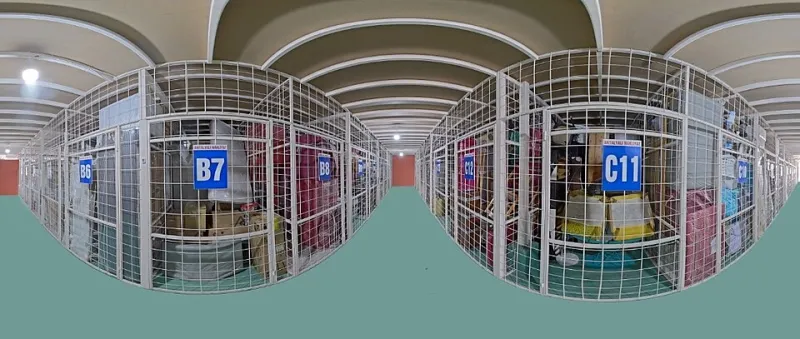
Photo: KafesDepo, CC0, via Wikimedia Commons
Self-storage is America's accidental monument to surplus. It appears at the edge of town, along highway frontage roads, and behind strip malls: rows of roll-up doors, security gates, fluorescent lights, and signs advertising the first month free. The industry has grown into a familiar real-estate asset class, but its climate footprint is rarely part of the conversation. That is a mistake. Storage is not a neutral container for extra belongings. It is a built environment with energy demand, land-use consequences, and embodied carbon, and it is expanding.
The Boom Behind the Doors
Industry estimates place the number of U.S. self-storage facilities in the tens of thousands, with hundreds of millions of square feet of rentable space. The exact figures vary by source, but the cultural pattern is clear: many Americans have more possessions than their homes can hold, and the market has responded by building warehouses for the overflow. The units are marketed for transitions, downsizing, business inventory, and temporary need. In practice, many rentals become long-term. The stuff goes in, the door comes down, and the monthly payment continues.
The climate-controlled segment is especially important. Not every storage unit is heated or cooled, but a significant share advertises climate control to protect furniture, electronics, documents, and other sensitive goods. That means continuous ventilation, dehumidification, heating, cooling, and lighting, often in large, low-occupancy buildings with substantial envelope losses. A storage facility is not an office or a home, but it still consumes energy around the clock. The difference is that the energy is being spent on things no one is using.
Land, Concrete, and Steel
Self-storage also has a land-use story. The model depends on cheap or peripheral land: former industrial parcels, highway-adjacent fields, and undeveloped edges of suburbs. These locations are often automobile-dependent, which adds parking lots, drive aisles, and stormwater runoff. In some cases, storage competes with more productive uses such as housing, light industry, or conservation. In others, it occupies land that is cheap precisely because it is flood-prone, contaminated, or poorly served by infrastructure. The result is a sprawling, low-density built form that is difficult to retrofit and expensive to serve with transit.
Then there is embodied carbon. Every facility requires concrete foundations, steel framing, metal roofing, insulation, roll-up doors, pavement, and climate-control equipment. Those materials carry emissions from extraction, manufacturing, and transport. A storage building may be less carbon-intensive per square foot than a hospital or a laboratory, but the scale of the boom matters. Thousands of facilities, each with a long material supply chain, add up. And because storage is often built for a relatively short investment horizon, the industry has less incentive to pursue the kind of deep durability or adaptive reuse that would justify the upfront carbon.
The Consumption Behind the Container
The deeper issue is not the warehouse. It is the reason the warehouse is needed. Self-storage is a symptom of a consumption system that encourages acquisition, discourages repair, and makes disposal inconvenient. Americans are not simply storing furniture and holiday decorations. They are storing the unresolved consequences of purchases: the exercise equipment, the extra couch, the inherited boxes, the business inventory that did not sell. Storage allows people to postpone decisions. It converts clutter into a monthly fee and keeps the underlying consumption out of sight.
That framing matters for climate policy. A storage unit does not create emissions the way a car or a power plant does, but it helps sustain a material culture in which goods are bought, kept, and eventually discarded with little regard for their full life cycle. The longer an item sits unused in a climate-controlled unit, the more energy is spent protecting it from the environment. The climate cost is not just the electricity bill. It is the embodied carbon of the item itself, the emissions from the building that houses it, and the land that could have been used for something else.
Green Storage Is Not Enough
In 2026, the storage industry is greening at the edges. Some operators are installing solar arrays, switching to LED lighting, improving insulation, and using smart controls to reduce energy waste. Those changes are worth making. Efficiency improvements can lower operating costs and reduce emissions. But they cannot resolve the structural problem. A solar-powered warehouse for unused stuff is still a warehouse for unused stuff. Efficiency can make a bad system less bad, but it does not change the system.
A more serious response would treat storage as part of a broader material-use agenda. Local governments could examine whether self-storage is consuming land that should be reserved for housing or industry. Building codes could encourage adaptive reuse of existing structures rather than new greenfield construction. Right-to-repair rules, repair cafés, tool libraries, and robust secondhand markets could reduce the flow of goods into storage. Deconstruction and material-reuse programs could keep building materials out of landfills. Extended producer responsibility could make manufacturers bear more of the cost of what they make.
The Question Behind the Door
The self-storage boom is often described as a response to American mobility and abundance. It is also a physical expression of a culture that has not yet learned how to let go. The climate price is not the only cost, but it is a revealing one. It shows how seemingly ordinary consumption choices become concrete, steel, electricity, and land.
A more sustainable future will not require Americans to live without storage. It will require a more honest accounting of what is being stored, why, and at what cost. The warehouse of surplus is not just a building. It is a mirror. What it reflects is a society that has made keeping everything easy and deciding what matters much harder.