When Wilderness Returns: The Economic Fault Lines Running Through America's Rewilding Movement
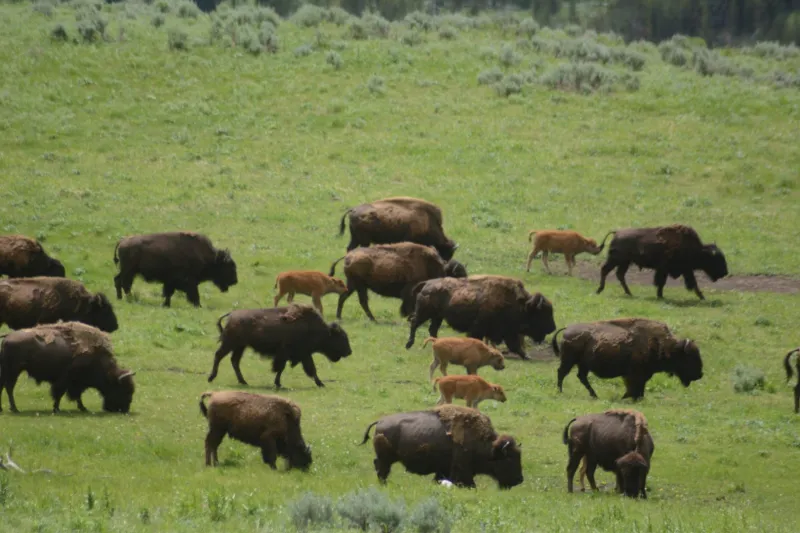
Photo: rewilding grassland bison restoration rural landscape conservation, via rewilding.org
In the spring of 2022, a coalition of conservation organizations finalized the purchase of nearly 100,000 acres of former timber land in northern Maine, adding it to the growing patchwork of protected territory that now forms the backbone of the proposed Downeast Lakes Wilderness Corridor. For ecologists, the acquisition represented a milestone—another segment of connected habitat capable of supporting wide-ranging species, storing carbon at scale, and buffering nearby communities from the intensifying effects of climate disruption.
For a portion of the region's residents, it represented something else entirely: the removal of productive land from the local tax base, the loss of timber jobs that had anchored family economies for generations, and the arrival of what some described as outside interests redefining their home on their behalf.
Both reactions are legitimate. And the collision between them is playing out, in varying forms, across dozens of landscapes from the Northern Rockies to the Appalachian highlands.
The Ecological Case Is Compelling
The scientific rationale for rewilding has grown substantially more robust over the past decade. A landmark 2020 study in Nature estimated that protecting and restoring 30 percent of the planet's land and ocean areas could prevent the extinction of approximately 70 percent of species currently at risk while sequestering enough carbon to meet roughly half of the emissions reductions needed to limit warming to 1.5 degrees Celsius.
In the American context, rewilding typically involves some combination of passive restoration—removing barriers to natural succession and allowing ecosystems to recover without intensive management—and active intervention, including the reintroduction of keystone species whose absence has cascading effects on ecosystem function. The reintroduction of gray wolves to Yellowstone National Park in 1995 remains the most studied example of the latter, demonstrating how a single apex predator can restructure vegetation, stabilize riverbanks, and increase biodiversity across a landscape through what ecologists call a trophic cascade.
Beyond biodiversity, rewilded landscapes deliver measurable climate services: carbon sequestration in recovering forests and grasslands, improved water retention that reduces flood risk, and the restoration of natural fire regimes that, paradoxically, can reduce the catastrophic wildfire risk that unmanaged fuel accumulation creates.
Where the Economic Calculus Gets Complicated
The problem, from the perspective of rural communities, is that these ecological services are largely invisible on a balance sheet. A standing forest sequesters carbon that benefits the entire planet. The community adjacent to that forest does not receive a carbon dividend. The tax revenue that once flowed from timber harvesting, grazing leases, or mineral extraction does not flow from a conservation easement at the same rate. The jobs do not transfer automatically.
In Haaland v. Brackeen and related federal land-use disputes, rural stakeholders have increasingly framed conservation-driven land transitions as a form of economic displacement—one that maps, not coincidentally, onto existing geographic inequalities between urban policy centers and rural extraction economies.
This framing has merit even when its political packaging is problematic. Research from Headwaters Economics, a Montana-based independent research group, has consistently found that federal land protections correlate with stronger long-term economic performance in adjacent counties—largely through outdoor recreation, tourism, and quality-of-life-driven in-migration of higher-income residents. But that aggregate finding masks significant distributional inequity: the workers who lose logging or ranching jobs are not typically the same people who open outfitting businesses or remote-work from restored landscapes.
Models That Are Actually Working
The most promising responses to this distributional problem are emerging from initiatives that treat ecological restoration and economic development as co-dependent rather than competing objectives.
Payments for Ecosystem Services (PES) programs offer landowners—including ranchers, farmers, and tribal nations—direct financial compensation for managing their land in ways that generate measurable ecological benefits. Voluntary carbon markets have made this model increasingly viable for private landowners, though the integrity of those markets remains contested. More durable are government-administered programs like the USDA's Conservation Reserve Program, which pays agricultural producers to take environmentally sensitive land out of production, and emerging state-level water quality trading programs that compensate landowners for reducing nutrient runoff.
In the Northern Great Plains, the American Prairie organization has pioneered a model that blends large-scale bison restoration with economic partnerships that benefit neighboring ranching communities—including wildlife-compatible grazing agreements that allow ranchers to continue operating on conserved land while contributing to ecosystem recovery goals. The initiative remains controversial among some local stakeholders, but its hybrid structure represents a genuine attempt to share the economic value of restoration rather than concentrate it.
Agritourism and nature-based recreation have delivered documented economic returns in multiple rewilding contexts. In the Blackfoot Valley of Montana, collaborative conservation efforts involving The Nature Conservancy, local ranching families, and tribal partners have supported a recreation economy—hunting, fishing, wildlife viewing—that now generates revenue comparable to traditional agricultural income on some participating properties. Critically, that revenue flows to existing landowners rather than displacing them.
Tribal-led rewilding offers perhaps the most instructive models for integrating ecological restoration with community sovereignty and economic self-determination. The Confederated Salish and Kootenai Tribes' bison restoration program on the National Bison Range in Montana, completed following a landmark federal transfer of management authority in 2020, demonstrates that Indigenous stewardship can deliver both ecological performance and community economic benefit when tribes retain meaningful control over the terms of restoration.
The Equity Question Cannot Be Deferred
The rewilding movement's long-term viability as a climate strategy depends on its ability to answer the equity question honestly and early. Conservation initiatives that arrive in rural communities with predetermined outcomes, inadequate community engagement, and no mechanism for sharing economic benefits will generate the opposition they deserve—and in doing so, will undermine the broader project of building a political coalition capable of protecting land at the scale the climate crisis demands.
The ecological science is clear: we need more functioning wild land, more connected habitat, more landscape-scale carbon sinks. The social science is equally clear: durable conservation requires the genuine participation and tangible benefit of the people who live closest to the land being restored.
Those two imperatives are not irreconcilable. But reconciling them requires conservation organizations, federal agencies, and policymakers to treat economic justice not as an afterthought to ecological ambition, but as its necessary precondition. The future of American rewilding will be written in that negotiation—and the terms matter enormously.