Ground Zero: Alaska's Melting Permafrost Is Unleashing a Climate Crisis America Can No Longer Ignore
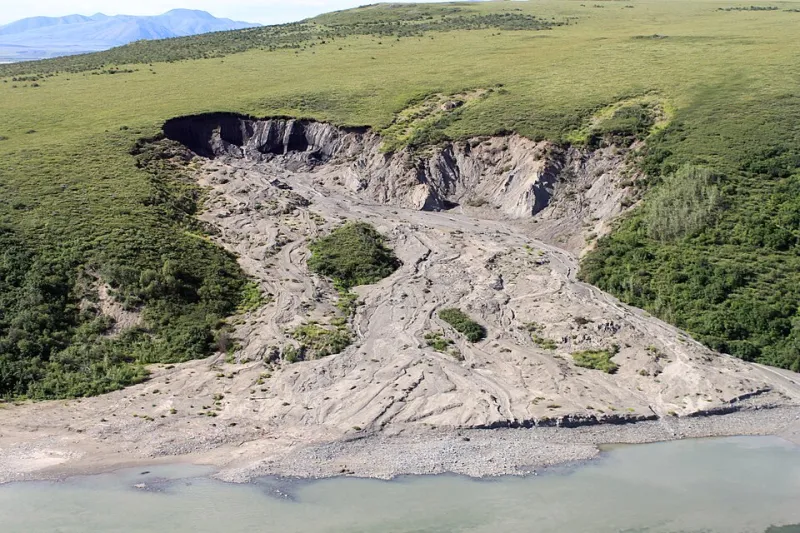
Photo: NPS Climate Change Response, CC BY 2.0, via Wikimedia Commons
For most Americans, permafrost is an abstraction — a geological footnote tucked somewhere between the weather report and a nature documentary. But for the nearly 700,000 residents of Alaska, and for climate scientists who have spent careers studying Earth's most vulnerable latitudes, the accelerating thaw of this frozen ground represents something far more immediate: a structural emergency, a carbon catastrophe, and a civilizational stress test arriving ahead of schedule.
Permafrost — ground that remains frozen for at least two consecutive years — underlies roughly 85 percent of Alaska's landmass. For millennia, it has served as a kind of planetary deep freeze, locking away vast quantities of organic carbon that accumulated during the last ice age. Today, driven by Arctic temperatures rising at nearly four times the global average, that frozen infrastructure is failing. And the consequences are cascading in ways that neither economists nor climate models have fully reckoned with.
The Ground Beneath Their Feet Is Disappearing
In communities like Newtok, Shishmaref, and Kivalina — small, predominantly Alaska Native villages perched on coastlines and riverbanks — permafrost thaw is not a policy abstraction. It is the reason houses tilt at impossible angles, the reason roads buckle and sink, the reason entire communities are being forced to contemplate relocation at enormous financial and cultural cost.
The Army Corps of Engineers has identified more than 30 Alaskan communities facing imminent threats from erosion and flooding worsened by thawing permafrost. The relocation of a single village — Newtok, home to roughly 400 Yup'ik residents — has already cost federal and state agencies more than $100 million, and the process is far from complete. Multiply that figure across dozens of at-risk communities, and the fiscal exposure runs into the billions.
Beyond residential structures, Alaska's critical infrastructure is bearing the strain. The Alaska Department of Transportation estimates that climate-related damage to roads, bridges, and airports could cost the state between $5.5 billion and $7.6 billion over the next two decades. Pipelines that traverse permafrost terrain — including segments of the Trans-Alaska Pipeline System — require increasingly expensive engineering interventions to remain stable. The economic model that once made Arctic resource extraction viable is being quietly undermined by the very ground it depends upon.
A Carbon Time Bomb With a Global Fuse
The infrastructure costs, as staggering as they are, may ultimately be the lesser concern. Scientists estimate that Arctic permafrost contains approximately 1.5 trillion metric tons of organic carbon — roughly double the amount currently present in the atmosphere. As permafrost thaws, microbial activity accelerates the decomposition of this ancient organic matter, releasing carbon dioxide and methane into the atmosphere in a feedback loop that amplifies the very warming driving the thaw.
This is what climate researchers call a positive feedback — and it is among the most alarming dynamics in contemporary Earth system science. A 2022 study published in the journal Nature Climate Change found that permafrost thaw could release enough carbon to add between 0.3 and 0.5 degrees Celsius of additional warming by 2100, beyond what current emissions trajectories already project. That may sound modest in isolation, but in the context of international agreements straining to hold warming to 1.5 degrees Celsius above pre-industrial levels, it is a margin that could prove decisive.
Particularly troubling is the role of methane. While carbon dioxide is the more abundant greenhouse gas released by thawing permafrost, methane — emitted in waterlogged, anaerobic conditions increasingly common in thawing landscapes — carries a warming potential roughly 80 times greater than CO₂ over a 20-year horizon. Thermokarst lakes, the water-filled depressions that form as ice-rich permafrost collapses, are potent methane emitters and are proliferating across the Alaskan interior at measurable rates.
Critically, these emissions are not fully captured in current national or global carbon accounting frameworks. The United States' climate commitments, ambitious as they may be, were not calibrated to absorb a permafrost carbon feedback of this magnitude. Policymakers working from outdated models are, in effect, navigating with an incomplete map.
Indigenous Communities at the Intersection of Injustice and Expertise
The communities most acutely affected by permafrost collapse are also among those least responsible for the emissions driving it. Alaska Native peoples — whose cultures, subsistence practices, and spiritual identities are deeply intertwined with specific landscapes — are confronting forced displacement from ancestral homelands not of their choosing and not of their making.
Yet these same communities possess generations of observational knowledge about Arctic systems that Western science is only beginning to formally integrate. Indigenous land managers in Alaska have documented changes in freeze-thaw cycles, shifts in animal migration patterns, and alterations in river behavior that precede or corroborate instrumental records. Organizations like the Alaska Native Tribal Health Consortium have been vocal in demanding that federal climate adaptation funding prioritize community-led relocation and infrastructure resilience — demands that have met with inconsistent responses from successive administrations.
The moral and political dimensions here are inseparable from the scientific ones. Any serious national strategy for managing permafrost-related risks must center the voices and sovereign rights of the communities already living inside this crisis.
What Investment and Policy Must Do Next
The financial sector is beginning, slowly, to register permafrost risk. Some institutional investors and insurance underwriters are factoring Arctic infrastructure vulnerability into their risk assessments for Alaskan energy and real estate assets. But the pace of this recognition lags dangerously behind the pace of thaw.
A coherent federal response would encompass several dimensions. First, dramatically expanded monitoring networks — the current permafrost observation infrastructure in Alaska is chronically underfunded relative to the scale of the phenomenon being tracked. Second, dedicated adaptation financing for Alaska Native communities facing imminent relocation, structured as grants rather than loans to avoid compounding existing inequities. Third, the integration of permafrost carbon feedbacks into official U.S. climate projections and international negotiating positions, ensuring that domestic and global targets reflect the full scope of what is being released.
The Inflation Reduction Act represented a historic investment in clean energy transition, but it allocated comparatively little to Arctic adaptation or permafrost science. Closing that gap is not merely a regional priority — it is a prerequisite for any credible national climate strategy.
The Urgency Beneath the Surface
There is a particular cruelty in the way permafrost thaw operates: largely out of sight, unfolding across landscapes that most Americans will never visit, measured in centimeters of annual subsidence and parts per million of atmospheric carbon. It does not generate the dramatic imagery of a wildfire or a hurricane. It is, in the most literal sense, a slow disaster.
But the science is unambiguous. The economic costs are already accumulating. The carbon feedback is already in motion. And the communities living at the epicenter of this transformation are already making impossible decisions about where — and whether — their futures can be built.
The thaw will not wait for policy calendars or election cycles. What happens beneath Alaska's surface in the coming decades will shape the climate arithmetic that every American, and every person on Earth, inherits. That is a story The Green Medium will continue to tell — because the ground beneath our collective future is shifting, and the window for meaningful intervention is narrowing with every degree of warming we fail to prevent.