Cooling Down Is Heating Us Up: The Vicious Climate Cycle Hidden Inside America's Air Conditioners
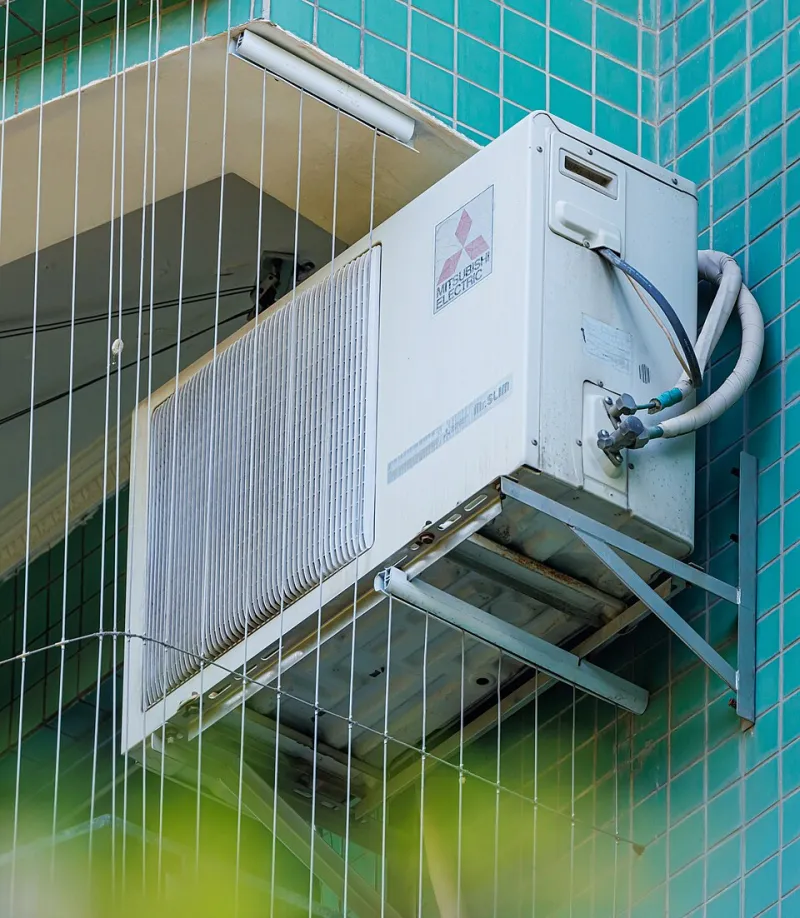
Photo: Dinkun Chen, CC BY-SA 4.0, via Wikimedia Commons
Somewhere in Phoenix this past summer, a grandmother left her air conditioner running continuously for eleven weeks straight. In Chicago, office buildings chilled their interiors to near-sweater temperatures while the sidewalks outside baked at over 100 degrees Fahrenheit. Across the Sun Belt, the question of whether you could afford to run your AC had become, quite literally, a matter of life and death.
America's relationship with mechanical cooling has long been treated as a cultural given — a background hum of modern comfort as unremarkable as running water. But as climate change compresses the window between tolerable and dangerous heat, that background hum is growing into a roar with measurable consequences for the planet's future.
A Self-Reinforcing Emergency
The United States is home to more air conditioning units than any other nation on Earth. According to the U.S. Energy Information Administration, roughly 90 percent of American homes have some form of air conditioning — a figure that has risen steadily over the past three decades and shows no sign of plateauing. Cooling now accounts for approximately 6 percent of the country's total electricity consumption, generating around 117 million metric tons of carbon dioxide annually.
The uncomfortable arithmetic is this: higher temperatures produce greater demand for cooling, greater cooling demand increases electricity consumption, and that electricity — still substantially generated from fossil fuels across much of the country — releases greenhouse gases that warm the atmosphere further. Climate scientists have a term for this dynamic: a positive feedback loop. In colloquial terms, it is a trap, and the United States is walking deeper into it every summer.
Projections from Lawrence Berkeley National Laboratory suggest that global cooling energy demand could triple by 2050, with the United States contributing a disproportionate share. What makes this particularly urgent is the compounding nature of the problem: as the grid strains under peak cooling loads on the hottest days, utilities often resort to their least efficient, most polluting "peaker" plants to meet demand — facilities that sit idle for much of the year and exist solely to absorb those summer spikes.
The Refrigerant Problem Nobody Is Talking About
Beyond electricity consumption, there is a second, less visible dimension to the air conditioning crisis: refrigerants. The chemical compounds that make mechanical cooling possible have historically been among the most potent greenhouse gases known to science. Chlorofluorocarbons (CFCs), banned under the 1987 Montreal Protocol, gave way to hydrofluorocarbons (HFCs), which carry no ozone-depleting properties but possess global warming potentials hundreds to thousands of times greater than carbon dioxide.
The 2016 Kigali Amendment to the Montreal Protocol set an international schedule for phasing down HFCs, and the United States formally ratified that agreement in 2022. The EPA's AIM Act is now driving a domestic transition toward next-generation alternatives, including hydrofluoroolefins (HFOs) and natural refrigerants such as CO2, ammonia, and propane. These substances offer dramatically lower climate impacts, though each presents its own engineering and safety trade-offs that manufacturers are still working to resolve at scale.
The transition is underway, but it is proceeding at the pace of industrial inertia rather than ecological urgency. Millions of existing units will continue operating on legacy refrigerants for decades, and improper disposal remains a significant source of atmospheric leakage. A more aggressive policy framework — one that accelerates retrofits and tightens disposal standards — would meaningfully reduce the sector's climate footprint without waiting for the full generational turnover of equipment.
Building Smarter, Not Just Cooling Harder
Perhaps the most durable solution to America's cooling crisis does not involve better air conditioners at all. It involves buildings that need less cooling in the first place.
Passive cooling — an architectural philosophy rooted in centuries of vernacular building practice — uses design rather than machinery to maintain comfortable interior temperatures. Strategic orientation, deep roof overhangs, cross-ventilation, thermal mass, and reflective or green roofing materials can collectively reduce cooling loads by 30 to 50 percent in appropriately designed structures. Communities in the American Southwest historically built with adobe precisely because its thermal mass absorbs daytime heat and releases it slowly overnight, flattening the temperature curve without electricity.
Contemporary architects and engineers are revisiting these principles through a modern lens. High-performance building envelopes — combining advanced insulation, triple-glazed windows, and airtight construction — dramatically reduce heat infiltration. Cool roof technologies, which reflect solar radiation rather than absorbing it, are now code-mandated in several states and have demonstrated measurable effects not only on individual buildings but on urban heat island temperatures more broadly.
The barrier is not knowledge. It is incentive. American building codes, while improving, still lag significantly behind the energy performance standards of peer nations. Developers operating under short-term cost pressures consistently underinvest in efficiency measures whose returns materialize over decades. Reforming building codes at the state and municipal level — and coupling that reform with financial incentives for retrofitting existing housing stock — represents one of the highest-leverage interventions available to policymakers.
Smart Grids and the Demand-Side Revolution
For the cooling that remains necessary, the question shifts to when and how it draws power. Smart grid technologies offer a partial but meaningful path forward. Demand response programs, already operating in dozens of utility territories, allow participating households to pre-cool their homes during periods of low grid stress and renewable energy abundance, then reduce consumption during peak hours. When paired with smart thermostats — devices now installed in tens of millions of American homes — these programs can shave demand peaks without meaningfully compromising comfort.
Thermal energy storage represents a more ambitious version of the same idea. Systems that freeze water or cool specialized materials overnight, then use that stored "coldness" to condition spaces during the day, effectively decouple cooling demand from peak electricity hours. Several commercial buildings and district cooling systems across the country have deployed this technology with demonstrable results. Scaling it to the residential sector remains a cost and installation challenge, but one that targeted subsidies could meaningfully address.
Who Bears the Heat
No honest accounting of America's cooling crisis can sidestep the question of equity. The communities most exposed to extreme heat — lower-income neighborhoods, communities of color, urban cores with minimal tree canopy — are frequently the least equipped to manage it. Aging housing stock with poor insulation, limited access to capital for efficiency upgrades, and utility bills that consume an outsized share of household income create a landscape in which the most vulnerable bear the greatest burden of a problem they contributed least to creating.
The Inflation Reduction Act's energy efficiency tax credits and low-income weatherization provisions represent a meaningful, if incomplete, step toward addressing this disparity. The Low Income Home Energy Assistance Program (LIHEAP) helps millions of households manage cooling costs, but its funding has never kept pace with rising temperatures or energy prices. Designing climate policy that treats cooling access as a public health imperative — rather than a private consumer choice — is not merely a matter of fairness. It is a prerequisite for building the political coalitions that durable climate action requires.
The Feedback Loop Has an Exit
The paradox at the heart of America's cooling crisis is real, but it is not inescapable. A coordinated response — accelerating the refrigerant transition, tightening building performance standards, integrating cooling systems into smart grid architecture, and ensuring that efficiency investments reach the households that need them most — could substantially reduce the sector's climate footprint even as temperatures continue to rise.
What the moment demands is a willingness to treat air conditioning not as an isolated consumer product but as an infrastructure challenge with planetary stakes. The machines keeping Americans alive in an increasingly hostile climate are part of the same system producing that hostility. Recognizing that connection is the first step toward breaking the loop.