Vanishing Night: America's Brightest Pollutant Is One We Never Switch Off
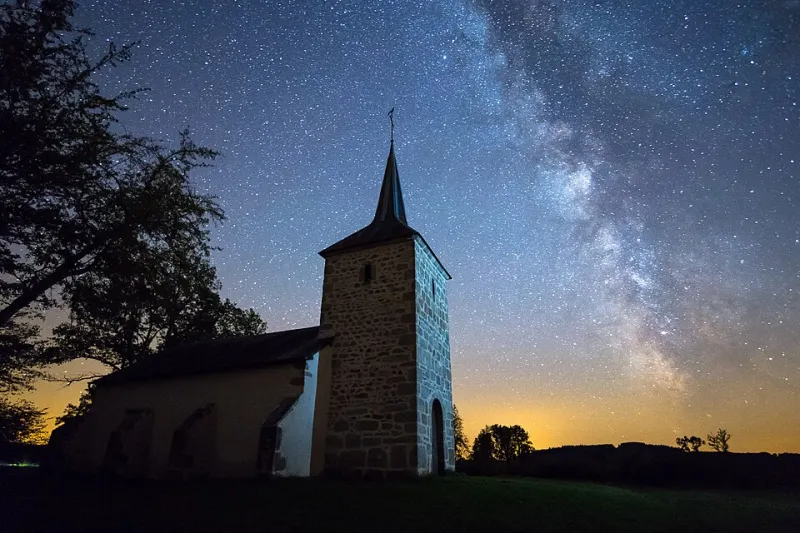
Photo: Benh LIEU SONG, CC BY-SA 4.0, via Wikimedia Commons
Stand on the rim of the Grand Canyon after sunset and you will see something most Americans no longer experience: a sky crowded with stars. Drive three hours toward Phoenix, however, and that celestial canopy dissolves into a dome of artificial glow. Astronomers call it skyglow. Ecologists call it something closer to a crisis.
Light pollution is the fastest-growing pollutant on the planet — and uniquely, it leaves no residue in soil or water. A 2023 analysis published in Science found that the night sky over observing stations worldwide has brightened by roughly 10 percent annually for the past decade, a rate that doubles skyglow in under eight years. In the United States, where roughly 80 percent of residents can no longer see the Milky Way, the loss is not merely aesthetic. It is biological, behavioral, and deeply consequential.
The Biology of Darkness
Evolution did not prepare life on Earth for a planet that never goes dark. For nearly all of history, night meant night — and entire physiological and ecological systems were built around that rhythm.
Consider the billions of birds that migrate across American flyways each spring and fall. Nighttime migrants navigate using stars and the moon, but they also appear drawn to artificial light like sailors to a lighthouse. During the 9/11 tribute in light in New York City, researchers documented tens of thousands of birds circling the twin beams in a single night, disoriented and exhausted. The National Audubon Society's Lights Out programs in Chicago, Houston, and Philadelphia — cities positioned along critical migration corridors — have shown that simply dimming or shutting off decorative lighting during peak migration measurably reduces fatal building collisions.
Insects fare no better. A growing body of research links nighttime illumination to declines in pollinator activity, as moths and other nocturnal pollinators abandon illuminated areas or perish circling fixtures. Given that a substantial share of flowering plants depend on night pollinators, the implications ripple straight into agriculture and backyard gardens alike.
And along Florida's Atlantic coast, the stakes arrive in miniature. Sea turtle hatchlings instinctively crawl toward the brightest horizon — historically, the moonlit ocean. On developed beaches, they instead orient toward streetlights and condominium glow, wandering inland toward storm drains, roads, and predators. Volunteers in Brevard County patrol nesting beaches each season simply to redirect hatchlings that got the light signal wrong.
The Human Cost of a Brighter Night
The consequences are not confined to wildlife. The American Medical Association has warned since 2016 that pervasive nighttime exposure to blue-rich LED light suppresses melatonin production, disrupts circadian rhythms, and is associated with elevated risks of sleep disorders, metabolic dysfunction, and possibly certain cancers. Studies of communities near brightly lit industrial facilities have documented measurable sleep fragmentation in residents.
There is also a matter of equity. Light pollution, like every other environmental burden, is unevenly distributed. Research has shown that neighborhoods with higher proportions of lower-income residents and communities of color experience significantly greater skyglow exposure, layering circadian disruption atop an already long list of environmental stressors.
Wasted Light Is Wasted Energy
From a climate standpoint, the case against careless lighting is straightforward arithmetic. The International Dark-Sky Association estimates that at least a third of outdoor lighting in the United States is emitted upward or sideways — illuminating nothing but sky and costing billions of dollars annually in wasted electricity. Every wasted kilowatt-hour from unnecessary lighting is a kilowatt-hour generated, often by fossil fuels, for zero benefit.
This is what makes light pollution such a rare policy problem: the fix is cheap, immediate, and largely reversible. Unlike carbon emissions or permafrost thaw, darkness returns the moment a switch flips.
Communities Proving the Point
Across the country, a quiet counter-movement is demonstrating that modern life and dark skies can coexist.
Flagstaff, Arizona, home to Lowell Observatory, adopted the nation's first comprehensive lighting ordinance in 1958 and has spent decades refining it — requiring fully shielded fixtures with warm color temperatures. The result is a city of 76,000 people where the Milky Way remains visible from downtown.
Northeastern Colorado's San Luis Valley, Texas's Big Bend region, and the communities surrounding Utah's national parks have pursued International Dark-Sky Community certification, adopting ordinances that mandate shielded fixtures, curfews for decorative lighting, and warm-spectrum LEDs that minimize blue emissions.
Crucially, these policies have not dimmed safety or commerce. Modern lighting science consistently shows that properly shielded, warm-colored, motion-activated lighting improves visibility and security — glare and overlighting actually degrade both. The DarkSky International model ordinance has become a template that municipalities from Maine to California are adapting with strikingly little resistance.
Taking the Night Back
Individual action matters here in a way it rarely does in climate policy. Homeowners can choose fixtures rated by the MLO (Model Lighting Ordinance) standards, install motion sensors instead of all-night floodlights, and select amber rather than blue-white bulbs. The five-minute test is simple: if you can see the bulb from 20 feet away, it is unshielded — and it is lighting up the wrong audience.
The stars over the Grand Canyon are not a luxury. Darkness is a shared ecological resource, as vital as clean air, and unlike most environmental challenges, this one is solvable within a single evening. The night is not gone. It is waiting for us to switch off.